804

autor
infoConstruct
distribuie


publicat
2026 May 12
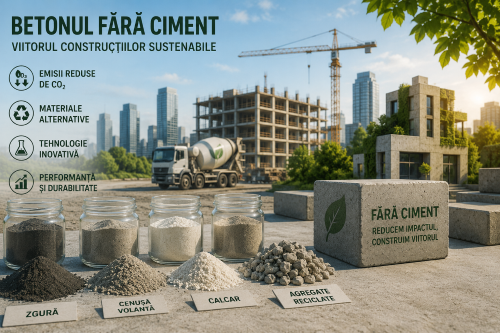
The construction industry is facing increasing pressure to reduce carbon emissions, and cement is one of the main contributors to this impact. Its production generates approximately 7–8% of global CO₂ emissions, driving the search for viable alternatives.
Cement-free concrete, based on technologies such as geopolymers or the use of recycled materials, is one of the most intensively explored directions. These solutions can significantly reduce the carbon footprint by using industrial by-products such as fly ash or slag.
Pilot projects in Europe and Asia demonstrate that these materials can achieve structural performance comparable to traditional concrete. However, large-scale adoption remains limited by the lack of standardization and the industry’s reluctance to move away from conventional materials.
One of the major obstacles is the regulatory framework. Construction standards are primarily designed around traditional cement, and the introduction of new materials requires extensive testing, certification, and long-term validation.
From an economic perspective, initial costs may be higher, but these can be offset by environmental benefits and future regulations regarding emissions taxation.
For Romania, the transition toward alternative materials could represent a significant opportunity, especially in the context of investments in infrastructure and green construction. Integrating cement-free concrete into pilot public projects could accelerate both adoption and the development of the local industry.
In the long term, reducing dependence on traditional cement is no longer an option, but an inevitable direction. The question is not whether this change will happen, but how quickly the industry will be able to implement it on a large scale.
(Photo: AI GENERATED)
aflat
read