940

autor
infoConstruct
distribuie


publicat
2025 December 12
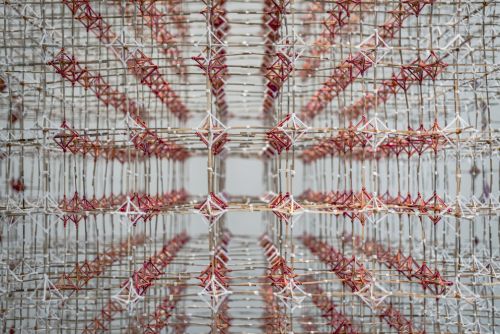
3D concrete printing is fundamentally changing the way we build: faster, more efficient, and with zero material waste. But a new trend is beginning to take shape in Europe – the integration of natural fibers into the composition of 3D concrete. Romania, with abundant resources of flax, hemp, and reed, has enormous and still unexplored potential in this field.
Why are natural fibers important in 3D concrete? 3D-printed concrete requires a special composition: fluid enough for extrusion, yet strong enough to self-support immediately. Natural fibers bring critical benefits:
- ductility and crack resistance,
- increased elasticity,
- good shrinkage behavior,
- reduced carbon footprint,
- the possibility of replacing synthetic and polymer-based materials.
In addition, plant fibers interact well with the mineral matrix, especially when they are pre-treated.
What can Romania offer? Romania is one of Europe’s largest historical producers of technical hemp and has extensive areas of high-quality flax and natural reed beds. These resources can become key components for low-carbon 3D concrete mixes.
Local advantages include:
- short supply chains,
- low raw material costs,
- high added value for export,
- the possibility of creating new circular industries.
Innovation: bio-reinforced 3D concrete with Romanian fibers International research shows that hemp, flax, or reed fibers can significantly improve tensile strength and crack behavior. In 3D printing, these fibers help stabilize deposited layers and reduce the risk of deformation.
An optimal mix would include:
- short hemp fibers (5–20 mm) for ductility,
- flax fibers for strength,
- reed fibers for volume and structural stability.
These materials can transform 3D concrete into a much more ecological composite adapted to local resources.
Possible applications in Romania 3D-printable houses with a reduced carbon footprint, ideal for social housing programs. Rapid modules for tourism in natural areas, where environmental impact must be minimized. Customized prefabricated elements, produced locally at low cost. Structures for agriculture: storage facilities, shelters, greenhouses.
The Danube Delta area, for example, could become a hub for bio-reinforced construction materials based on reed.
Why is this topic not being discussed? Lack of connection between the agricultural and construction industries. Limited infrastructure for fiber processing at an industrial scale. Lack of demonstrative projects showing real benefits.
However, the adoption of 3D printing in construction is growing, and pressure for low-emission materials will inevitably open this direction.
Romania has a rare competitive advantage: abundant natural resources and an emerging 3D construction printing market. Integrating flax, hemp, and reed fibers into 3D-printed concrete compositions can place the country at the forefront of sustainable construction materials. It is an opportunity that almost no one is talking about, but one that could transform both the construction industry and local agriculture.
(Photo: Freepik)
aflat
read