1011

autor
infoConstruct
distribuie


publicat
2025 December 16
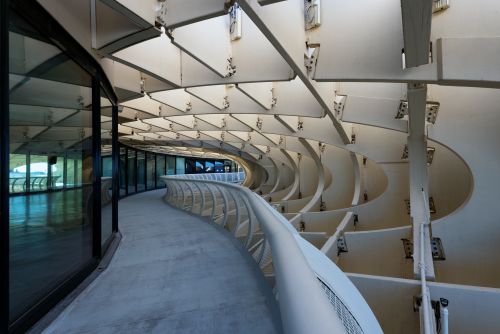
Against the backdrop of increasing pressure for low-energy buildings, a technological solution is beginning to gain attention in Europe: Building-Integrated Wind Turbines (BIWT). Unlike conventional wind turbines, these systems use wind tunnels and vertical micro-turbines integrated directly into building architecture, transforming urban air currents into a constant source of energy.
The principle is simple yet effective. The building’s form is designed to channel and accelerate airflow through dedicated zones—facades, vertical voids, or passages between volumes. The concentrated wind drives silent vertical turbines capable of generating energy even at low wind speeds typical of urban environments.
A major advantage of these systems is their adaptability. Vertical micro-turbines do not require orientation based on wind direction, have low vibration levels, and can operate under turbulent conditions. This makes them suitable for office buildings, industrial facilities, logistics centers, or multi-storey parking structures. The generated energy is used locally, for lighting, ventilation, control systems, or charging auxiliary electrical infrastructure.
For Romania, the potential is significant but still largely unexplored. Urban areas exposed to dominant air currents, open industrial platforms, and buildings located in plains or wind corridors can directly benefit from this technology. Moreover, integrating BIWT into new developments or major refurbishments aligns with European requirements for nearly zero-energy buildings (nZEB).
From an economic perspective, these systems do not compete with conventional wind power but rather complement it. The investment cost is lower, maintenance is simplified, and service life is comparable to that of other building-integrated equipment. The real benefit lies in reducing grid dependency and increasing energy autonomy.
Integrated wind tunnels are not a spectacular solution, but a pragmatic one. In a construction industry increasingly focused on efficiency and technological integration, urban micro-wind systems may become a functional component of future architecture.
(Photo: Freepik)
aflat
read